
As the weather cools and hiking season begins, more hikers are heading to the mountains. In 2024, the Fire Services Department responded to 588 mountain rescue incidents, which resulted in 345 people injured and 15 fatalities. Although these numbers show a slight decrease compared to 2022 and 2023, they remain significant. Hiking safety is crucial, so here are several important safety tips. We’ll also introduce three hiking trails, hoping everyone can safely enjoy this hiking season!
Thorough Planning Prevents Problems
Before setting out, you must have a thorough understanding of your route. At minimum, know your starting and ending points, and prepare offline hiking maps or paper maps to ensure you can navigate and determine your location even without network coverage. Don’t rely on Google Maps, as it doesn’t detail hiking trails or show important features like topography, contour lines and streams, making them inadequate for navigation in the mountains. Additionally, understand the route’s length, elevation gain, trail conditions, and difficulty level to ensure they match your abilities.
Never attempt challenging routes without adequate preparation, or blindly follow others’ trail records without reviewing the details. If you’re a beginner, start with well-marked and maintained trails, such as the Country Trails or Nature Trails maintained by the Agriculture, Fisheries and Conservation Department (AFCD).
However, even with thorough preparation, unexpected situations can arise, such as weather changes, injuries, or physical discomfort. Therefore, when planning your journey, also identify exit points along the route where you can easily leave the trail. This is particularly important for longer routes, ensuring you can quickly return to urban areas or safe locations if emergencies occur.


Watch out for Weather Changes!
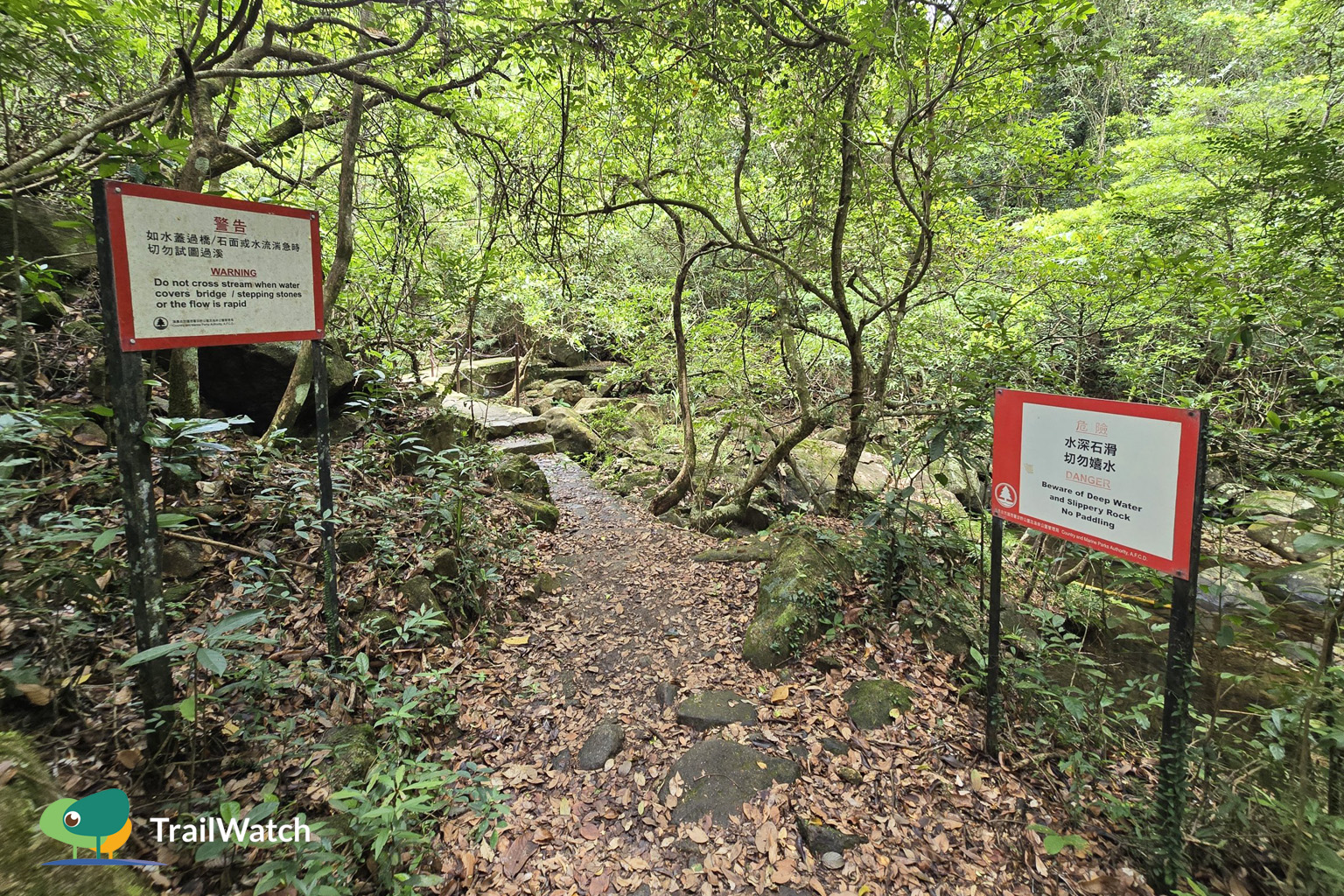
Near streams, you’ll often see “Beware of Flash Floods” signs, but did you know it comes in many different formats as well? When crossing streams, never let your guard down even if the water appears calm, especially during rainy seasons when flash floods are likely. The risk persists even after heavy rain has stopped. If you notice the water becoming murky or carrying mud and branches, it indicates rapid water flow upstream – a warning sign of an impending flash flood. You must immediately move away from the stream and vacate the area as quickly as possible.
Checking weather reports is essential before hiking. Several days before your hike, check the Hong Kong Observatory’s website or app for weather forecasts, and pack extra water, sun protection and rain gear as needed. On the day of your hike, continue monitoring weather changes closely, such as checking for thunderstorm warnings from the Observatory or observing if rain clouds are forming nearby. Be prepared to end your hike early if necessary.


Keep Your Distance from Wildlife – the Wilderness is Their Home!
Worried about wildlife attacks in the countryside? Remember, the wilderness is these animals’ home. Generally, when encountering common Hong Kong wildlife, you’ll be safe if you maintain distance and don’t disturb them. In areas frequented by wild boars and monkeys, simply keep your food and plastic bags secured and maintain a safe distance, as these items might attract them.
If you encounter a beehive blocking your path, try to find an alternative route. If pursued by a swarm of bees, avoid making large movements and protect your head and neck with clothing. If stung, carefully remove the stinger without squeezing the venom sac, then wash the affected area with clean water. Apply a cold compress to reduce swelling and pain. Monitor yourself for allergic reactions after being stung, and seek medical attention if necessary.


Trail Recommendations: No Need to Take Risks for Scenic Views!
We often see cases of national park visitors around the world falling off cliffs while getting carried away taking photos. In Hong Kong’s country parks, visitors are frequently seen climbing over barriers or onto cliff-edge rocks to take photos, creating dangerous situations. In fact, Hong Kong’s country parks offer many well-maintained trails with clear markings where you can enjoy beautiful views safely.
1. Lantau Peak, Stage 3 of the Lantau Trail
At 934 meters, Lantau Peak is Hong Kong’s second-highest peak. The summit offers spectacular panoramic views of Lantau Island’s mountain ranges and is also a popular spot for watching the sunrise. If you’re lucky, you might witness the stunning sea of clouds at dawn.
As part of the Lantau Trail, the path is clearly marked. The trail consists mainly of stone steps, with some sections being steep with high steps. This requires decent fitness – remember to hike within your abilities.


Recommended route: https://www.trailwatch.hk/en/plan-share/1042
2. Lion Rock
Starting from Tsz Wan Shan Road, take the stairs up to Sha Tin Pass Road to connect with Section 5 of the MacLehose Trail. After climbing up a series of stone steps, the view opens up to panoramic views of the Kowloon Peninsula. On clear days, you can see Hong Kong Island and even Lamma Island from the peak of the Lion Rock.
When taking photos at the summit, be mindful of where you stand. Never get too close to the edge of the cliff or climb over railings!


Recommended route: https://www.trailwatch.hk/en/plan-share/164169
3. Wilson Trail Section 4
Starting from the village houses and fields at Tseng Lan Shue in Sai Kung, join the Sai Kung Ancient Trail. After passing an aqueduct and crossing Tung Yeung Shan, continue along Fei Ngo Shan Road, passing Fei Ngo Shan Viewing Point and Jat’s Incline Viewing Point, finally reaching Lion Pavilion at Sha Tin Pass Road.
The trail offers magnificent views throughout, including Fei Ngo Shan, Elephant Mountain, and Tung Shan. From the top of Tung Yeung Shan, you can see Sai Kung’s mountains and islands. The Kowloon Peak Viewing Point also provides unobstructed views of Kowloon’s urban area.


Recommended route: https://www.trailwatch.hk/en/plan-share/1040
Conclusion
While enjoying nature’s beauty and exploring different corners of the wilderness, always remember to prioritize safety. Returning safely ensures you can continue hiking for years to come!