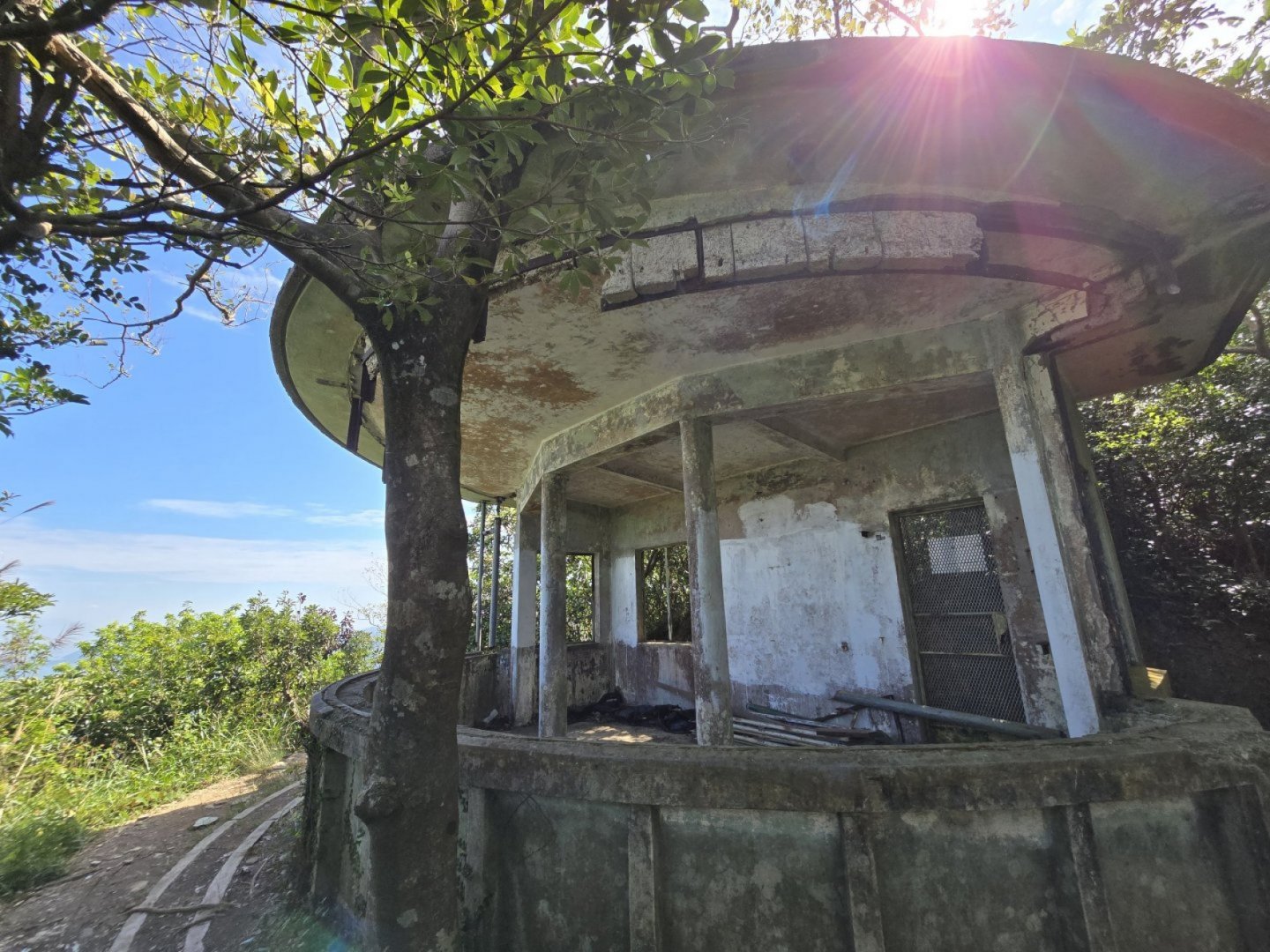
Each time we tread the hiking trails, the routes, trail conditions, and scenery change. In this edition, we introduce three “trails in transition”, hoping that as you walk in the mountains, you can catch a glimpse of the traces of change over time.
Former Frontier Closed Area: Robin’s Nest Country Park
Robin’s Nest Country Park was established in March 2024, making it Hong Kong’s newest country park. Despite the short history of the country park, the area within it is rich in historical and cultural heritage. Lin Ma Hang Village has a 300-year history, and the nearby mines date back to the early 19th century. During World War II, the area around Robin’s Nest was a Japanese military stronghold, and many Japanese military installations, including machine gun pillboxes, can still be seen today. Since the late 1940s, during the Chinese Civil War, areas including Robin’s Nest and Lin Ma Hang Village were designated as part of the Frontier Closed Area to prevent illegal border crossing. Seven MacIntosh Forts were subsequently built within the Hong Kong-Shenzhen border frontier closed area as observation posts, one of which is located near Lin Ma Hang.

Remains of the British Observation Post at Ah Kung Teng

Remains of a Japanese Pillbox with a new information plate
When Robin’s Nest Country Park was established, official hiking trails were constructed, making off-trail hikes along unmarked paths no longer necessary. Distance posts and trail signs were added, along with interpretive panels introducing local historical and military structures. Since 2012, the government has gradually opened up Frontier Closed Areas including Robin’s Nest. Starting from early 2025, visitors taking green minibus to areas near Lin Ma Hang Village were exempted from applying for Frontier Closed Area permits, making it even more convenient to visit the area.

The official country trail has clear trails, distance posts and road signs
As economic activity, military action and frontier policy shifts, so do the landscape around the Robin’s Nest.
Robin’s Nest Country Trail route for reference: https://www.trailwatch.hk/en/plan-share/274538
Concrete Trails: Nam Long Shan (Brick Hill)
Nam Long Shan (Brick Hill) has always been a popular spot for watching sunsets and a place where the residents of the Southern District exercise in the morning. In early 2024, the Southern District Office conducted trail works on Nam Long Shan, paving the dirt trail between Brick Hill Pavilion and the helipad with concrete. An additional path was even opened up beside the main trail to transport construction materials.

Path created to transport materials to construct the concrete path


Dirt path and wooden stairs in 2021 (left) and concrete path in 2024 (right)


Concrete stairs were added even at sections that are relatively flat (left: 2021; right: 2024)


The original trail showed signs of erosion (left, 2021), but gullies were created less than a year after the construction of the concrete trail (right, 2024)
When the construction began, the Concern Group on Concretization of Hong Kong Natural Trails expressed their worries. Rainwater cannot seep through concrete into the ground but instead gathers along both sides of the concrete trail, making erosion more severe and more likely to form gullies that are difficult to repair. If drainage is not taken into consideration, simply constructing concrete trails cannot solve the fundamental problem of erosion.
For readers who have revisited Nam Long Shan after the trail works, do you find the concrete-paved trail easier to walk on? Have you noticed any other changes to the trail?
Nam Long Shan route for reference: https://www.trailwatch.hk/en/plan-share/4102
Wan Kuk Shan Across Ten Years
Beyond concrete paving, wear and tear from human traffic also notably changes trails. Using Wan Kuk Shan as illustration, we searched through TrailWatch’s public activity records to observe the changes over the past decade.
As seen at the bottom of the photos, since 2020, steps have been constructed along the steeper section of the dirt trail. While admittedly not all hikers prefer walking on steps, they can help slow down water flow on steeper sections, decreasing erosion and slowing down erosion of topsoil. The photos also show that this section was built using eco-crafted trail construction techniques, utilizing natural wood for steps and backfilled with gravel and soil. Such techniques avoid the use of heavy machinery that could damage the trail, and blends in better with the surrounding environment.
Wan Kuk Shan route for reference: https://www.trailwatch.hk/en/plan-share/421
Conclusion
These three trails offer a glimpse into the overall changes occurring in Hong Kong’s countryside. As countryside development and policies are entering the public arena, perhaps we should pay even closer attention to the subtle changes under our feet.